
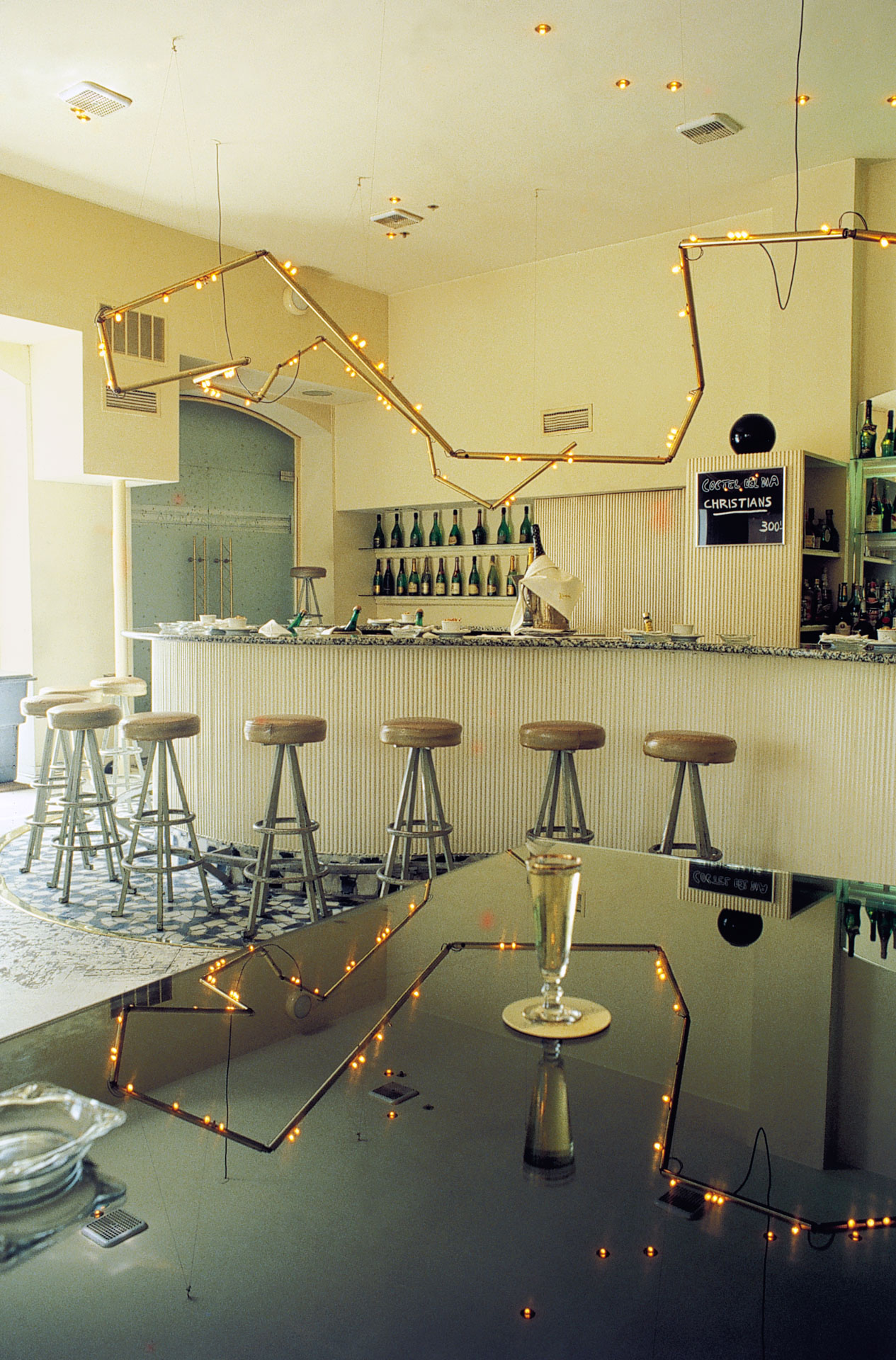
Lámpara especial articulada para La Xampañería. Barcelona, 1981.
Lighting, atmosphere, feeling
Gabriel Ordeig Cole, 1985.
Discussing complex subjects in general terms is no easy task. And in the case of light, that presence which is so immediate and palpable on the one hand and so vague and diffuse on the other, this becomes complicated indeed. So we should begin by describing the physical mechanisms through which we indeed see it.
Approximately 80% of human sensory impressions are optic in nature. To discuss light, then, is to discuss how man sees, and the importance of light – whether natural or artificial – as a vehicle of information for the development of any human activity.
Light is the sensation produced in the eye by electromagnetic waves. These waves are electromagnetic fields of differing frequency which transport energy through space, and propagate in the form of oscillations or vibrations. As with any wave movement, they are characterised by a wavelength and by an emission frequency. The relation of these two magnitudes forms a third: the speed of propagation. In the case of light, the speed of wave propagation is some 300,000 kilometres per second.
(…) But if discussing light means discussing how man sees, then an interesting question arises: Do we see the same way as people did 3000 years ago? According to the experts, today it can safely be asserted that man’s visual efficacy has not changed in the course of his known history, nor will it change in the future. It can be said that the capacity of the human eye has reached its limit and that higher effectiveness levels than those of today are inconceivable. This does not mean, though, that our perception is constant, since the meanings we give to things change through time and the centuries. The literary epics of ancient Greece, for example, make little mention of the colours of things, and some scholars in this area have gone so far as to suggest that in the past people did not see certain colours, or that they saw them otherwise.
Today we know that the selective capacity of their retinas was the same as ours, but that the meaning and interpretation they gave to what they saw were different. In the age of Homer, man considered the contrast between light and dark to be far more important than the contrast between a light blue and a dark blue. Colour was seen as a step in the direction of these absolute concepts: the presence or absence of light. Intermediate nuances were dispensed with. Light blue was day and dark blue was night.
Having now reached much higher lighting levels, our interpretation of colours, of what we see, is no longer established in such absolute terms. In any case, it is worthwhile recalling how in England and other northern countries far greater attention is given to making good use of daylight than in Mediterranean countries. This is due simply to the fact that in the north they have fewer hours of sunlight and that it is less intense. Hence they are accustomed to treating such a scarce commodity with respect.
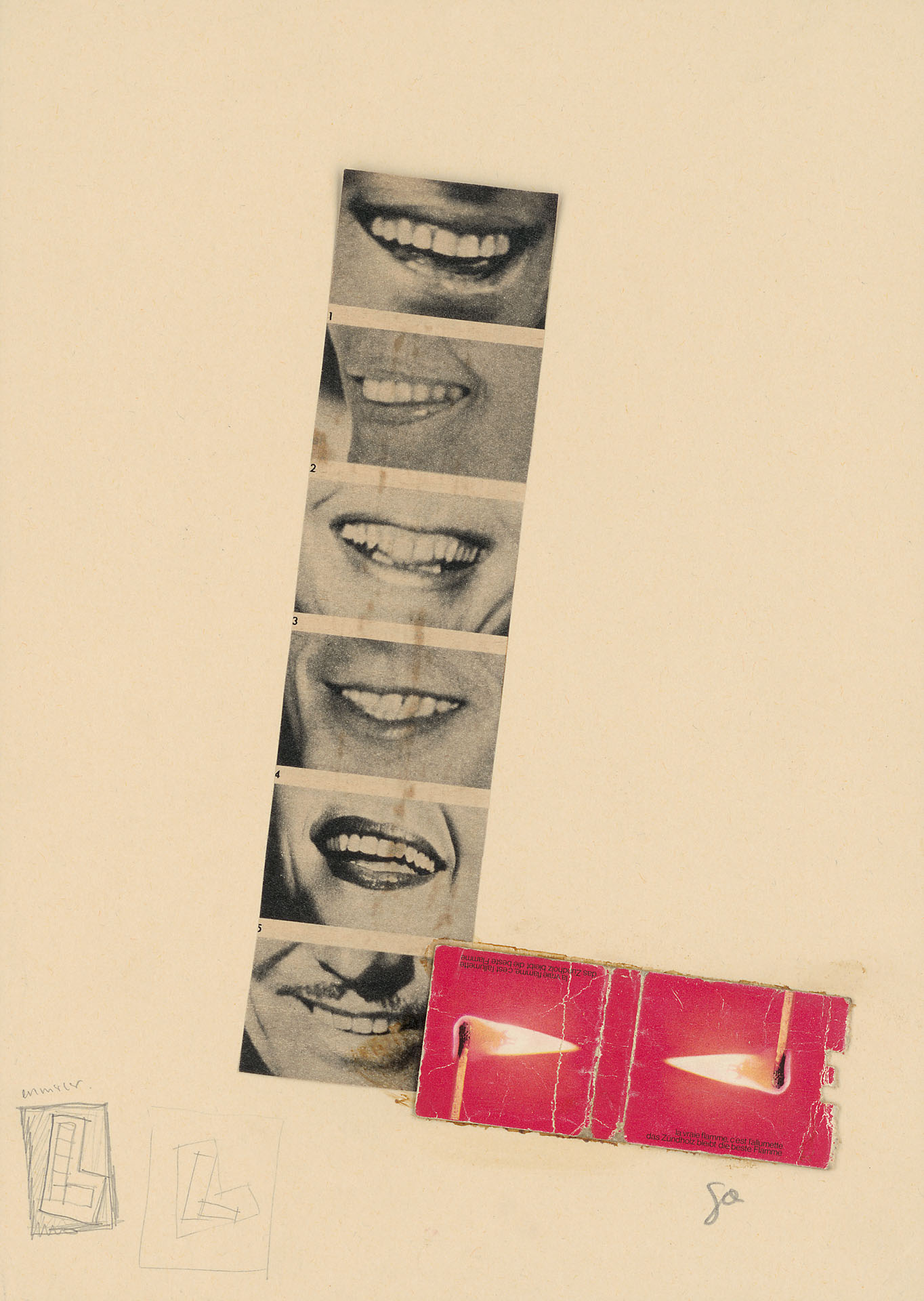
Collage.
The history of light is, to a large extent, the history of lighting. The sun, of necessity, is the source of inexhaustible light, without which there would be no life on the planet. And it is of such intensity that it is impossible to look directly at it without running the risk of burning our retinas. When we become aware of this fact as children, we also perceive the enormous power of this star.
Primitive man saw how light finished at night-time and was limited to the day. He could do next to nothing in the darkness of night and so therefore had to synchronise all of his activities with the sunlight hours. It was probably like this for thousands of years, until the discovery of fire. No one knows how, when or where this milestone occurred, but it was a finding that reaped huge benefits for the simple life of the tribal clan. With fire, troglodyte man felt accompanied. He could see at night, cook his food and frighten off wild beasts. He had succeeded in lengthening the day to suit his whim. People would gather around the fire and soon it became the centre of rituals and sacred ceremonies. It was the first means of lighting, the first lamp in history.
Torches, stone receptacles with animal fat and a primitive wick, tallow and oil candles, wax candles and, more recently, gaslights all were to follow. Yet it was not until the discovery of electricity and the incandescent light bulb that the history of lighting took a tremendous qualitative and quantitative leap forward.
(…) When Edison appeared on the scene, the basic problems of lighting had already been solved. However, the inexpensive long-lasting light bulb that could be used with high voltage electrical supplies and be manufactured in large numbers had yet to exist. Using the same principle that had guided his predecessors (namely, that, when an electric current passes through a body, it heats it, and so therefore it should be possible to find a conductor that would heat to incandescence, yet without burning out), he relentlessly experimented in order to improve the results obtained up to that point. On 21 October 1879 he produced the first lamp with potential for mass use. It consisted of a carbonised cotton thread filament, the two poles of which were connected to two conducting electrodes, and all this was inserted into a glass vacuum bulb. This light bulb remained lit for 45 hours and, soon after, Edison himself perfected it until it reached a duration of 600 hours.
Next, Edison & Co. set out to devise an entire system that would take electricity wherever it was needed. This system included wires, transformers, meters, sockets and switches. In 1880 he introduced the screw-in light bulb, very similar to the one used today, and which was easy for the general public to handle. And in 1882 he installed the first regular service for lighting private homes. At first, very few light bulbs were installed in each dwelling, and even today there are people in Spain who recall having a single light bulb in the kitchen and many metres of wire. Light was transported from one place to another within the private domain as needed.
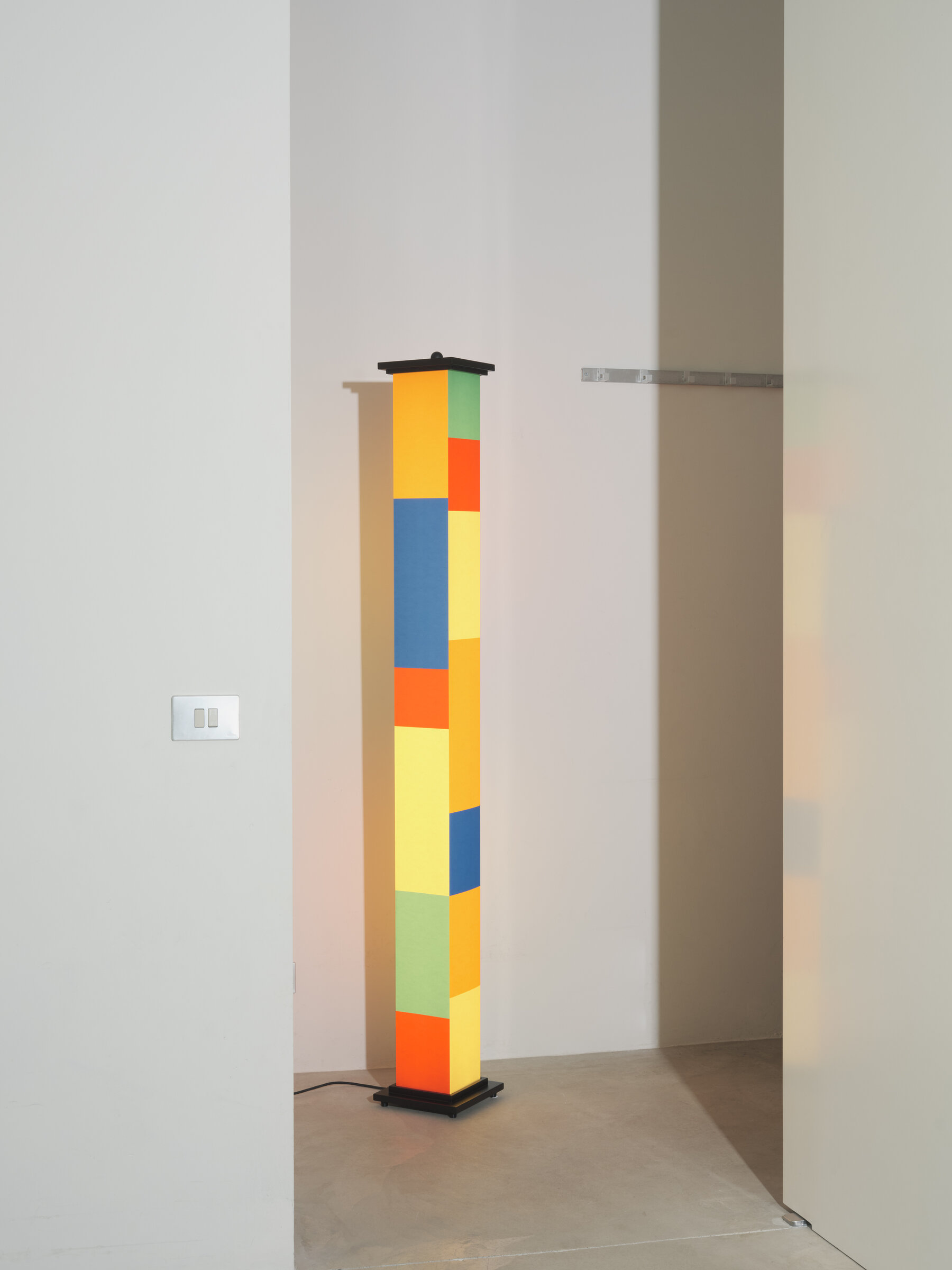
Lámpara de pie La Bella Durmiente diseñada junto a Nina Masó, edición de 2024.
At the beginning of the century, the incandescent light bulb became part of daily life. The era of major discoveries was over, and the disciples of those late-19th-century inventors restricted themselves to perfecting the legacy of their forebears. Nonetheless, improvements of unquestionable importance have been produced. The first fluorescent lamps appeared in the 1930s and halogen light bulbs in the late 1950s. Luminous efficacy (how much light a lamp generates from the energy it consumes) has increased thanks to the use of filaments made of metal instead of carbon, and light bulb life has been extended up to thousands of hours.
Although the combustion engine and chemical advances have likewise contributed to changes in our way of life, the introduction of electricity supposed a symbolic charge and unparalleled impact in the modern age. The development of wired electricity, of that vast infrastructure which effectively changed the world, sparked the sensitivity of its contemporaries. It was an impalpable, mysterious, almost mythological phenomenon.
Perhaps today, now that this phenomenon has been completely assimilated, it is light that continues to be impalpable, mysterious and intangible.
Despite the huge variety of lamps of all types, shapes and sizes now on the market, lighting our homes satisfactorily continues to be a problem. And at certain moments we prefer candlelight to the most sophisticated baroque, rustic or modern lamp. There is no deep-rooted tradition of qualitative appreciation of light, of its different effects depending on where it is placed, its intensity, colour and field of action. A space can change entirely according to its light. We can heat it or cool it, make it seem higher or lower, unify or fragment it. Our appreciation of form depends on how light is reflected in it.
A merely functional approach to the domestic lighting problem only bears in mind uniformity levels and suffers from a lack of sensitivity with respect to the surroundings. The sentimental approach can be even worse. Lamps are chosen because they match the “style” of the décor, without giving the slightest consideration to the type of light distribution required.
All things considered, it is only a matter of providing ourselves with a more pleasant living space. For this reason, it’s best to give lesser thought to lamps and more to light.