El quimono
William Merritt Chase
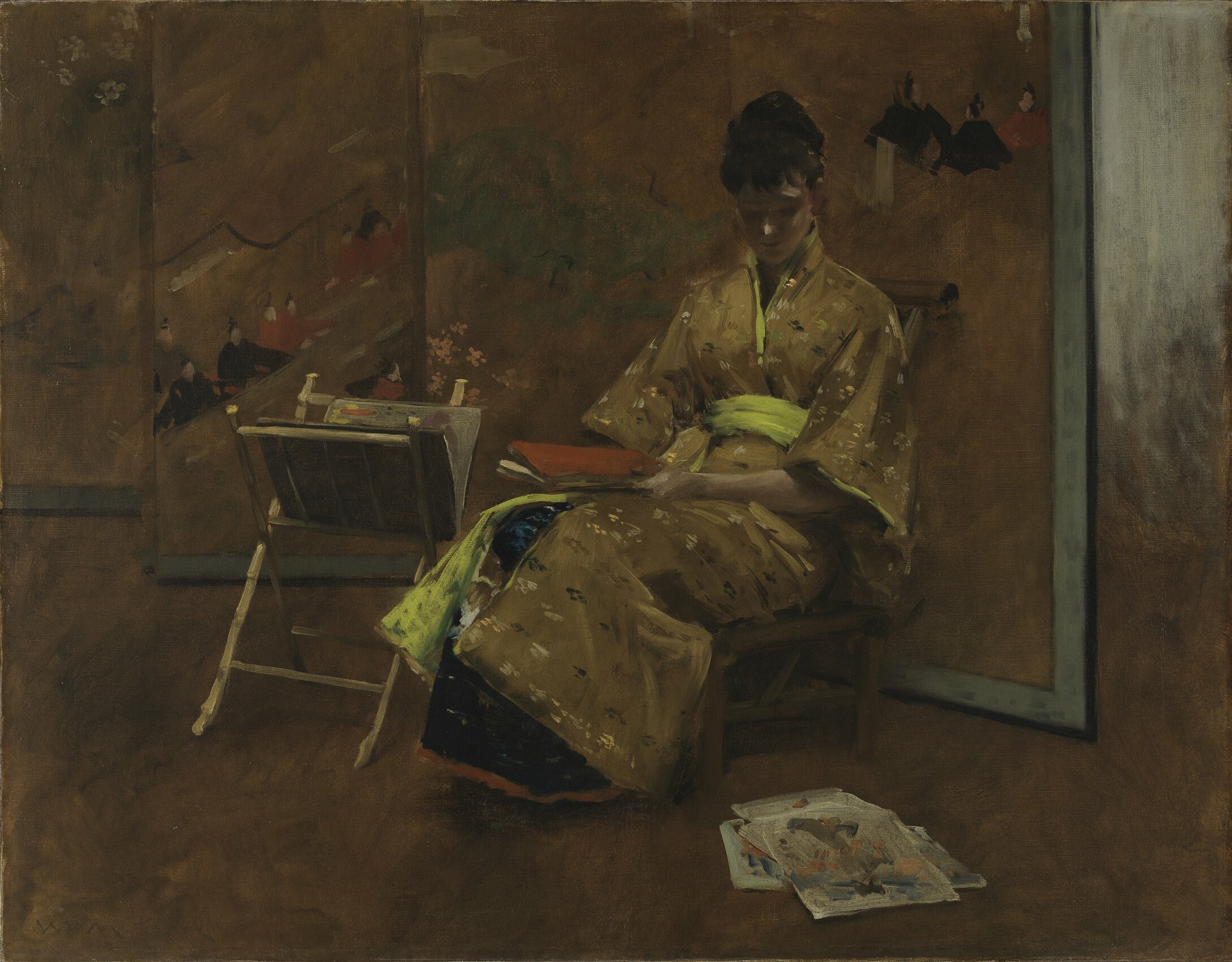
El quimono
Biographies

William Merritt Chase
A merchant’s son, William Merritt Chase was destined to inherit the family business. However, his interest in art spurred him to go against his parents’ wishes and he became a prominent painter on the American art scene on account of his energetic teaching work and involvement in many groundbreaking initiatives.
After the opening-up of Japan and the expansion of trade routes in the mid-nineteenth century, Japonisme immediately spread across Europe and America. Just as the paintings of the Paris Impressionists adopted certain compositional features of Japanese engravings and elements of Oriental styles, William Merritt Chase felt similarly attracted by everything Oriental. In the 1880s the American painter produced a series of “kimono portraits” of a few relatives and friends including A Girl in Japanese Gown in the Museo Thyssen-Bornemisza collection.
The artist’s enthusiasm for Oriental styles is closely linked to the influence of the Japanese-inspired paintings of James Whistler, as seen in Whistler’s Caprice in Purple and Gold: The Golden Screen. Furthermore, the ascending perspective and the asymmetry of the composition display the same influence but can also be related to another essential influence in Chase’s oeuvre, photography. In other respects, the concern Chase shows here for creating a mysterious, contemplative atmosphere and for modulating light, together with the loose brushwork, deserve him the title of pioneer of American Impressionism.
High resolution pigment ink on cotton paper
35.2 x 45.3 in
Same size as original
Next unit for sale No. 1
Open edition. Produced on demand
Certificate of authenticity included


45.3 in
35.2 un
William Merritt Chase
A merchant’s son, William Merritt Chase was destined to inherit the family business. However, his interest in art spurred him to go against his parents’ wishes and he became a prominent painter on the American art scene on account of his energetic teaching work and involvement in many groundbreaking initiatives.
Thyssen
The Thyssen-Bornemisza National Museum is a Madrid art gallery exhibiting the works of old and modern masters. It owes its existence to the lease agreement (1988) and the subsequent acquisition by the Spanish Government (1993), of the most valuable core of the private collection built over seven decades by the Thyssen-Bornemisza family.